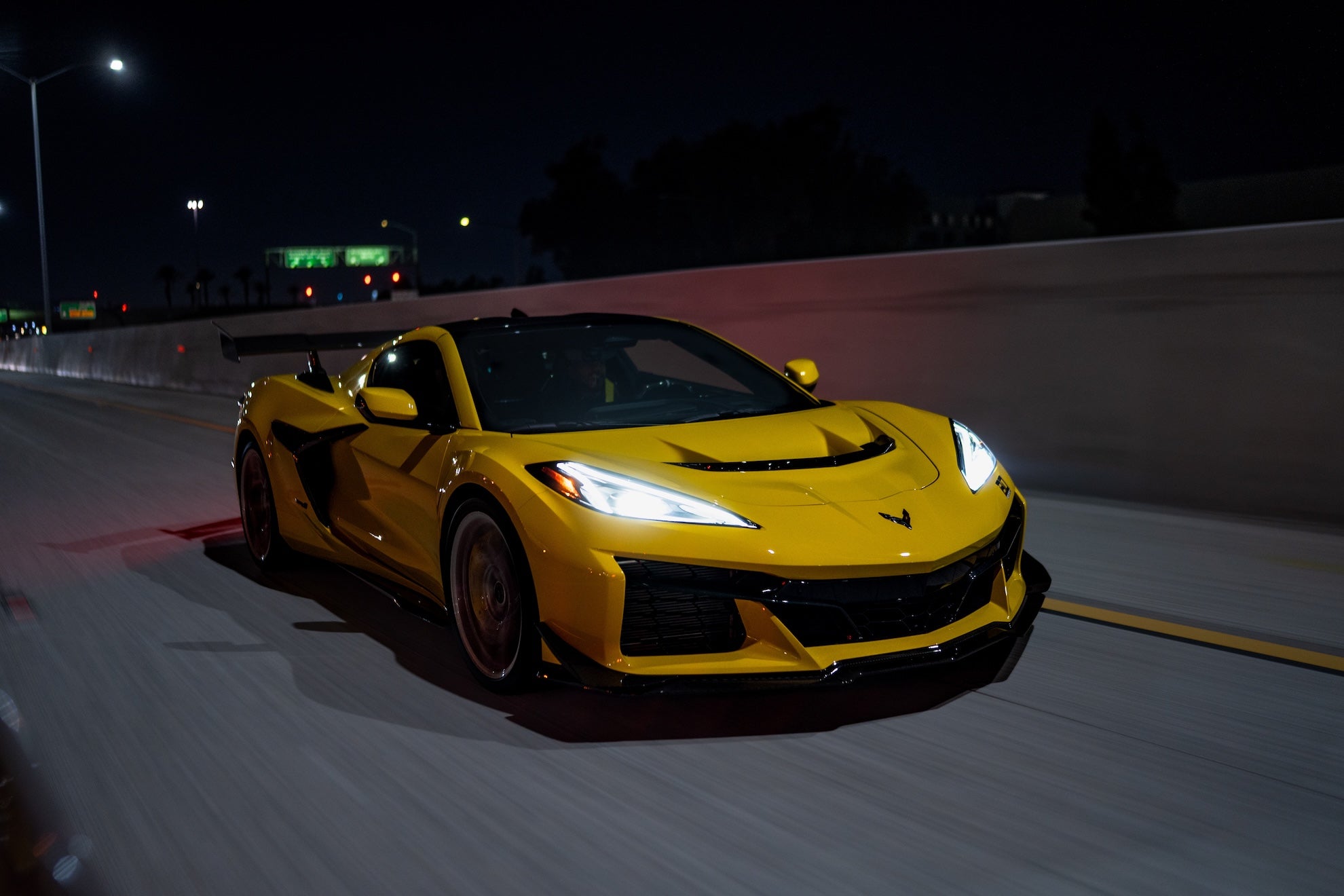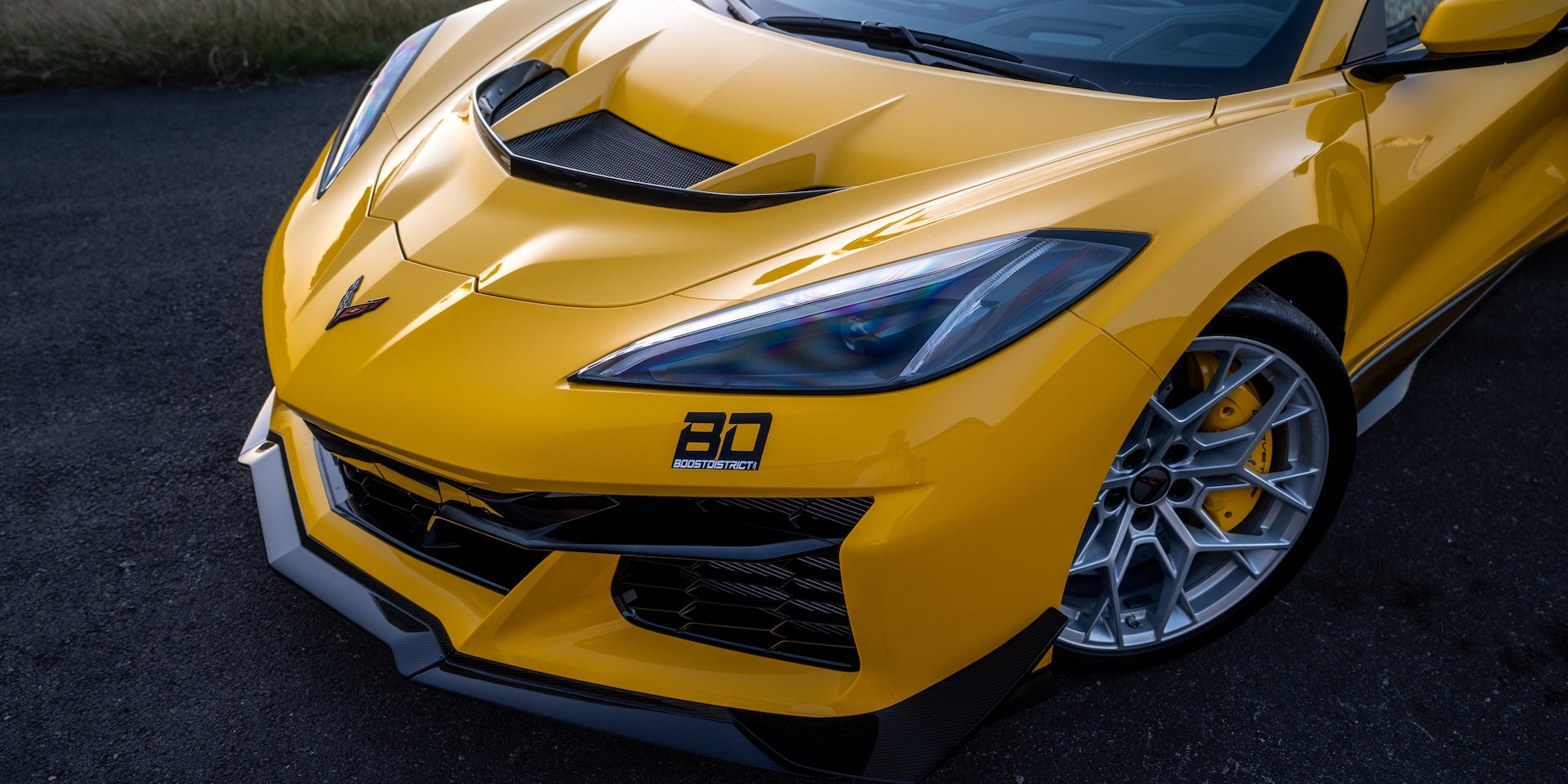
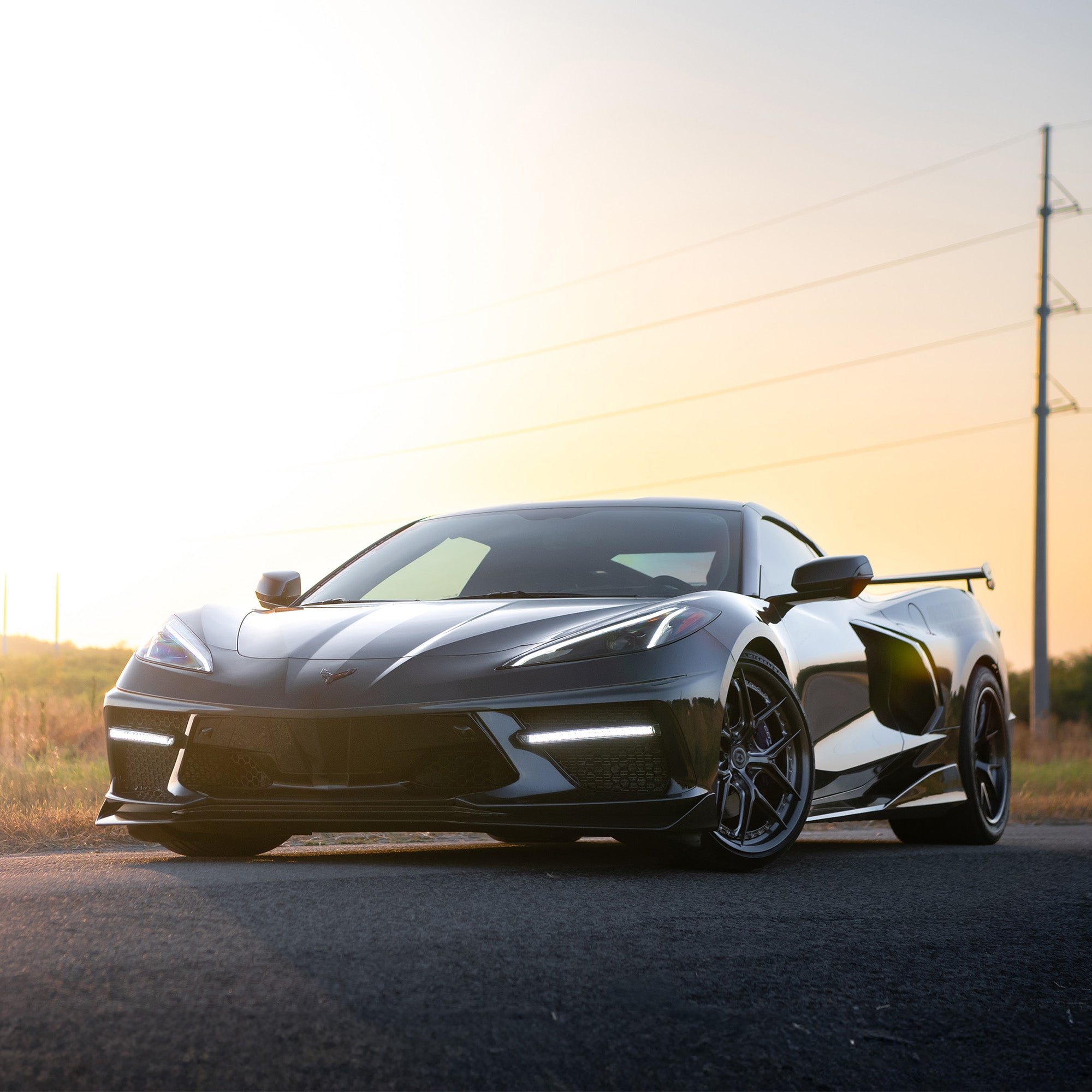
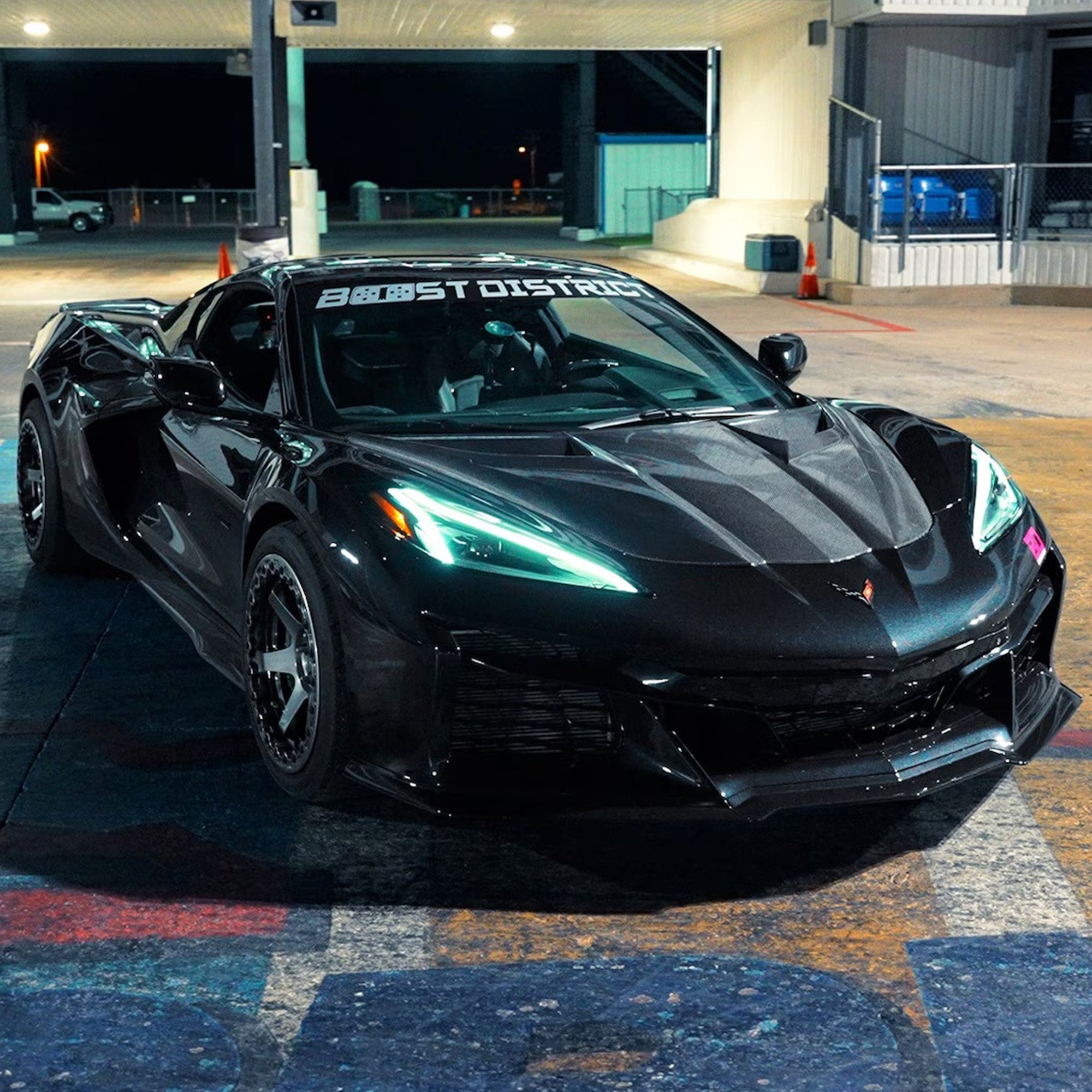
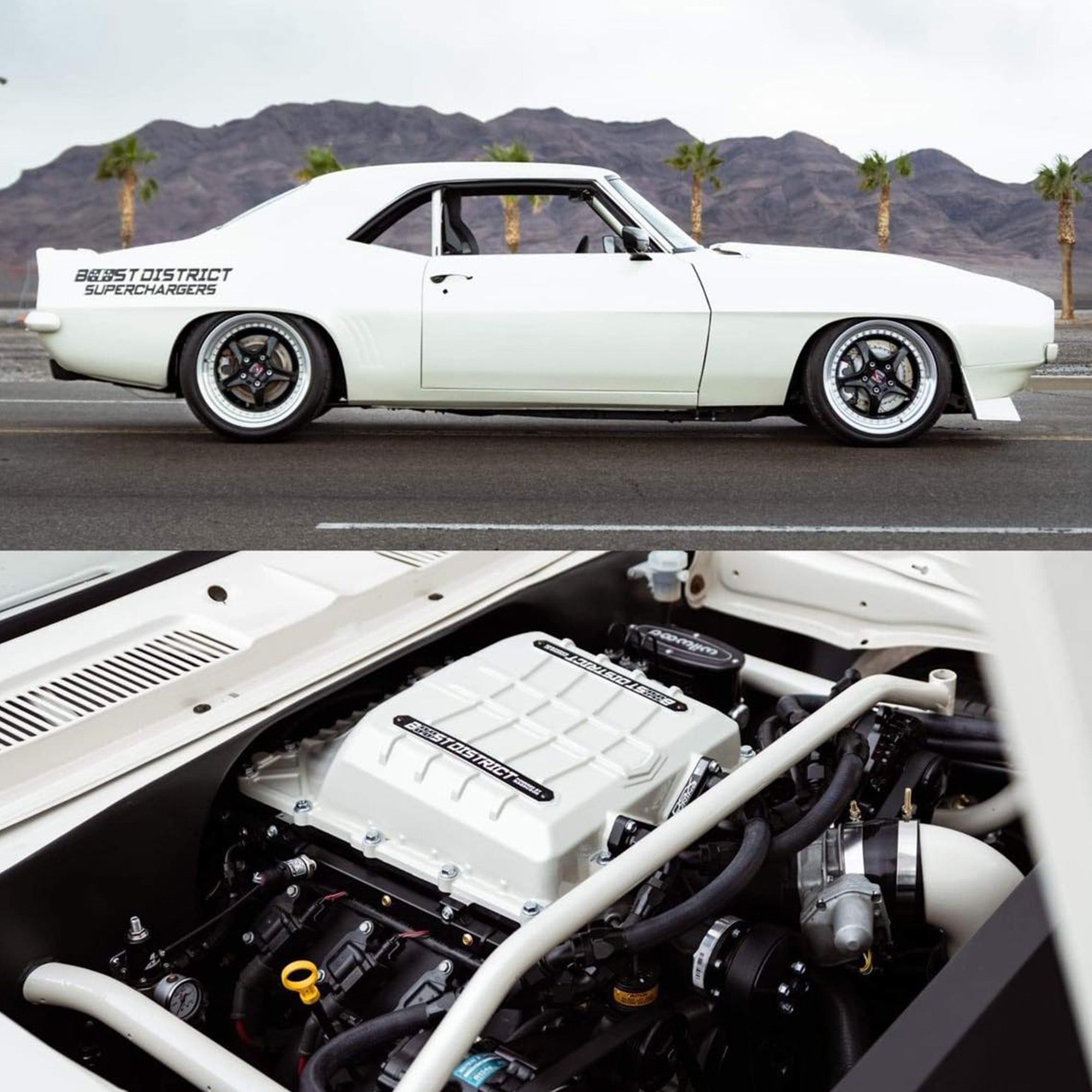
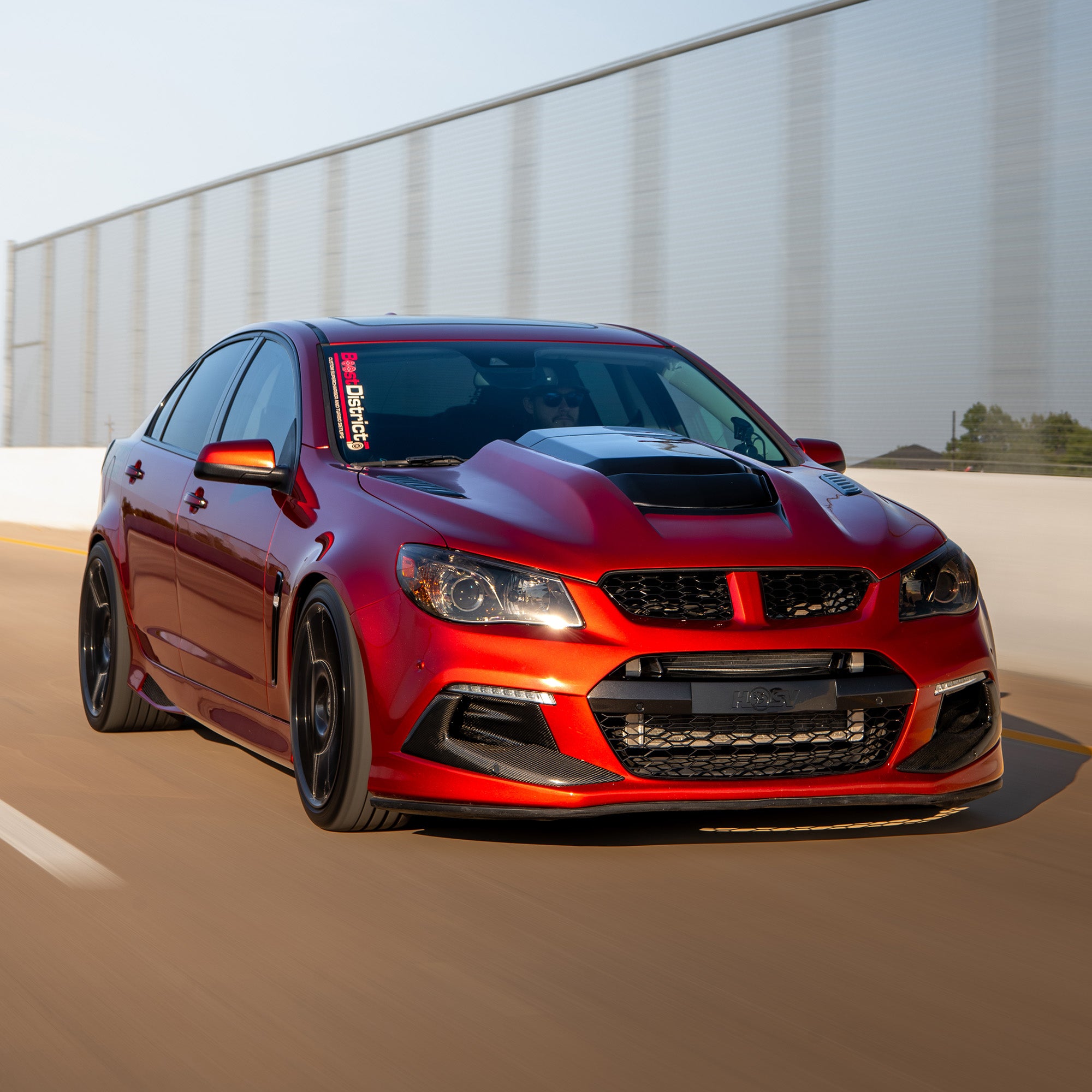

Top-Mount Twin Turbo Kit for the C8 Corvette — Coupe, Convertible, and Roof Exit

If you’ve been following Boost District for a while, you already know our bottom-mount twin turbo kit. We’ve built hundreds of them at this point, and they’ve been the foundation for record-setting builds across the C8 platform. But we’ve been quietly developing something different in parallel, a top-mount twin turbo kit that places the turbos right next to the headers, ZR1-style, for faster spool and a power curve that feels more like a supercharger off the line.
This is the complete breakdown. What the kit is, who it’s for, how it stacks up against the bottom-mount on the dyno, and what makes the Boost District version different from anything else on the market.
What the Kit Is

The Boost District top-mount twin turbo kit places the turbochargers high in the engine bay, directly adjacent to the exhaust manifolds, the same architecture GM used on the factory ZR1. That short, direct exhaust path is what makes the difference. Less plumbing between the engine and the turbines means quicker spool, more low-end torque, and a power delivery that feels immediate instead of laggy.
The kit is built around a few core components and design choices:
-
ZR1-style top-mount turbo placement next to the headers for minimum spool time
-
1,500-horsepower-capable ATS intercooler core, the same core platform we use on builds that have made 1,200+ wheel horsepower
-
Compatible with the factory exhaust (so you keep dual-mode valve operation) or with a cat-back of your choice
-
Custom heat-shielding and insulation engineered to protect the convertible top mechanism and surrounding components
-
Turnkey “in a box” delivery: turbos, plumbing, fuel system components, wiring, and a pre-mapped tune, designed for installation over a weekend
Three Configurations, Two Layouts
Top Mount - Convertible

Bottom Mount

Bottom Mount with Roof Exit Exhaust

The same fundamental kit is available in three configurations to cover every C8 Stingray owner:
|
Configuration |
Details |
|
Coupe — Street Exit |
Standard side-exit Stingray exhaust or Z06-style center-exit. The most common build. |
|
Convertible — Street Exit |
Same kit as the coupe, engineered to fit around the folding hardtop mechanism. Heat-tested for 700+ miles with no thermal issues. |
|
Coupe — “Wild Exit” Roof Exhaust |
Race-oriented configuration where the exhaust routes up through the rear deck and exits at the roof. Spits flames on the deck. Coupe only, the convertible’s folding roof mechanism occupies the space the roof exit would use. |
The convertible fitment matters more than people realize. Around 53 percent of all C8 Corvettes sold are convertibles, the majority of C8 owners on the road. We bought a 2025 convertible specifically to engineer this kit around it, because the new ZR1 is a coupe, the E-Ray is a coupe, and the Stingray we used for our earlier development was a coupe. Until now, the majority of the C8 market hasn’t had a real twin-turbo option built specifically for their car.
Top-Mount vs. Bottom-Mount: What’s Actually Different

This is the question we get the most, and the dyno tells the cleanest version of the story. Both kits use the same turbo core, the same intercooler architecture, and the same supporting hardware. The difference is where the turbos sit, and that single design choice changes how the car feels everywhere you drive it.
|
Spec |
Top-Mount |
Bottom-Mount |
|
Torque at 3,000 RPM |
505 lb-ft |
421 lb-ft |
|
Difference at 3,000 RPM |
+84 lb-ft |
— |
|
Power delivery feel |
Supercharger-like, immediate |
Some lag below boost |
|
Best driving range |
1,500–4,000 RPM (street driving) |
5,000–6,500 RPM (high-RPM, drag-focused) |
|
Visual impact |
Hidden up high near headers |
Visible — “obviously boosted” look |
|
Power ceiling |
1,200+ WHP proven on Stingray coupe |
Proven across hundreds of builds |
“That’s an 84 wheel-torque difference at 3,000 RPM. When you punch the gas pedal at 30 mph, you can wind up the tires and do a burnout. The power doesn’t come in with a big lag, it comes in gradually like a supercharger and stays on.”
Here’s the practical version: you don’t drive a C8 at 5,000 to 6,500 RPM all day. You drive it from 1,500 RPM when you’re coming off a red light up to 4,000 RPM as you’re working through the gears on a backroad. That’s the range where the top-mount kit lives, and it’s exactly the range where bottom-mount turbos still have a measurable response delay. The top-mount kit feels more like a supercharger in real-world driving while still giving you the headroom of a true twin-turbo platform.
The bottom-mount kit is still the right answer for some builds. It looks incredible, you walk up to the car and you immediately know it’s boosted. For roll-race builds and customers who care most about top-end power and visual impact, the bottom-mount remains a great choice. But for a street car, the top-mount’s response is hard to argue with.
Anti-Lag and Two-Step — On a Stock Steering Wheel

This is the part that doesn’t exist anywhere else. Boost District wrote the code for true anti-lag on the C8 ECU, including the 2025 model year, which nobody else has cracked, and we built the integration so you don’t need any extra buttons in the cabin to use it.
Everything maps to your stock steering wheel cruise control buttons. The only requirement is that cruise control is turned off on your dash display, once it’s off, the buttons re-route to the performance features:
|
Feature |
How It Works |
|
Anti-Lag |
Mapped to the cruise control ‘Cancel’ button. Hold it down, flat-foot the throttle from a roll, and the system pre-builds boost before you launch. On the dyno, hitting anti-lag added 60 horsepower and 60 lb-ft instantly at the start of the pull, the run jumped from 379 to 440. |
|
Two-Step Launch Control |
Mapped to the cruise control ‘Down’ button. Preset to 4,500 RPM. Hold the button while stationary, and the ECU holds RPM, builds boost, and cuts ignition for aggressive pops and flames out of the tips. |
|
Boost-By-Gear |
Available as part of the tune package for customers who want adjustable boost levels per gear. |
The reason this matters: turbo cars have always been missing the immediate hit that a supercharged car gives you. Anti-lag fixes that. You hold the button, you floor it from a roll, and the car responds like a supercharged car, instant, violent, no waiting for the turbos to wake up. Then the moment you stop using anti-lag, you’re back to a clean, civilized daily driver. No check engine lights, no compromises.
Dyno Numbers — Conservative, Daily-Driver Tune

The car you see in the video is running a deliberately conservative tune. The goal was a 10.50-second quarter-mile capability on the factory clutch, not a hero number, not a built-motor build. Just real, repeatable, daily-driver power.
|
Metric |
Result |
|
Peak Horsepower |
640 WHP |
|
Peak Torque |
606 WTQ |
|
Tune |
Conservative, low-timing, factory clutch |
|
Quarter-Mile Target |
10.50s |
|
Anti-Lag Hit |
+60 HP / +60 WTQ off the line |
That 640 number is entry-level for this kit. The turbo hardware itself supports 1,200+ wheel horsepower, we’ve proven that on our top-mount Stingray coupe. With a built clutch and a flex-fuel kit, this same kit on the same car would make low-700 wheel horsepower at minimum. The ceiling is far above where this car is tuned. We chose to keep it streetable for this build.
Engineered for DIY Install
One of the things we’ve focused on across our recent C8 product line is making these kits genuinely installable in a home garage. The top-mount kit ships as a complete package:
-
All turbo hardware, intercooler core, plumbing, and supporting components
-
Pre-mapped wiring harness with the anti-lag and two-step functionality already integrated
-
Fuel system upgrades sized for the power level
-
Plug-and-play tune, includes anti-lag, two-step, and optional boost-by-gear
-
Heat-shielding and insulation are pre-fitted for the convertible and coupe applications
If you’ve got the tools, the time, and a weekend, you can do this install yourself. If you’d rather have it done by the shop that engineered it, that’s what our build slots are for.
Which Kit Is Right for You?
Most C8 owners come to us asking the same question: top-mount or bottom-mount? Here’s the short version.
Choose the top-mount kit if:
-
You drive the car on the street more than on the track
-
You want a supercharger-like response in the 1,500–4,000 RPM range
-
You own a convertible (the top-mount kit is the only true twin-turbo solution that fits)
-
You want anti-lag and two-step on the factory steering wheel
-
You want the option to retain the factory dual-mode valved exhaust
Choose the bottom-mount kit if:
-
You’re primarily building a roll-race or top-end power car
-
You want the obvious, in-your-face boosted look
-
You’re chasing the highest possible peak power numbers with built engine support
Ready to Boost Your C8?

The Boost District top-mount twin turbo kit is available now for the 2020+ C8 Corvette Stingray, in both coupe and convertible. Three configurations: street-exit coupe, street-exit convertible, and the “Wild Exit” roof exhaust for race-oriented coupe builds.
Schedule your build or order the kit through the Boost District store. Questions on fitment or which kit is right for you? Reach out to our tech team, we’ve built hundreds of these, and we’ll walk you through your specific goals before you spend a dollar.